A castle in Alhambra, CA
October
I was ten years old the first time it got my attention. That probably says more about ten-year-olds than it does about the castle. It was Halloween night, and Tom and Ricky and I were working the neighborhood below the hill the way kids do when they’re serious about it — systematically, with pillowcases, not the little plastic pumpkin buckets the babies carried. Alhambra in October had a smell to it: eucalyptus and dry grass and someone’s fireplace going somewhere. You could hear the trees up on the hill rattling in the wind. I didn’t know what a eucalyptus was called yet. I just knew the sound.
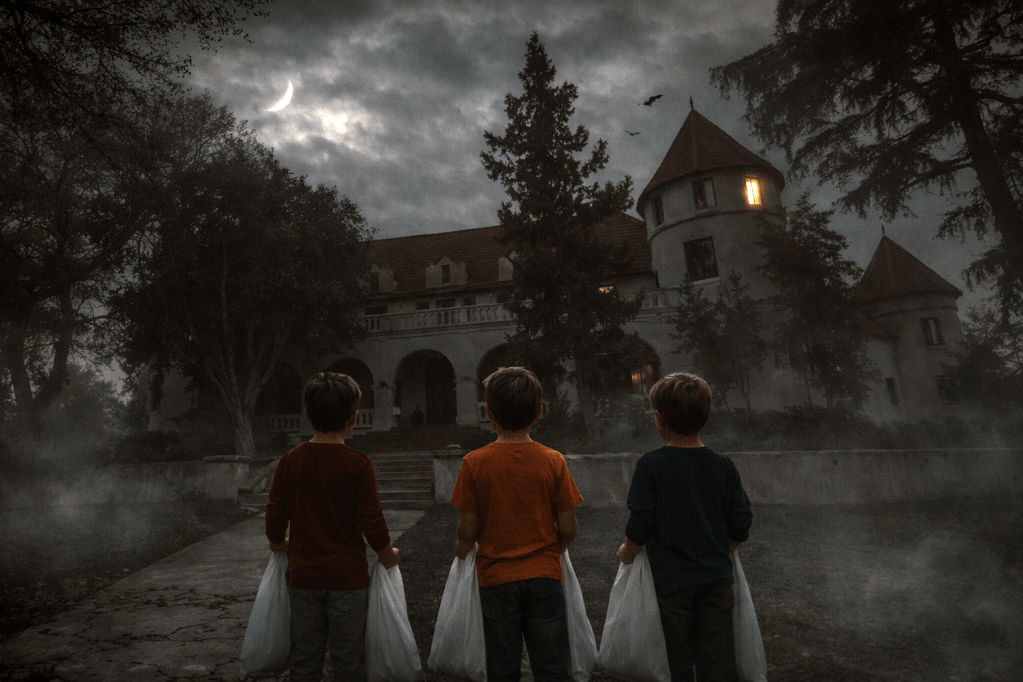
Tom stopped in the middle of the sidewalk and pointed up toward the dark shape rising above the rooftops. It was big. Bigger than the houses around it. It looked like something that had wandered in from another century and decided to stay.
“Let’s go up there,” he said. “Bet they give out full-size bars.”
That was the kind of reasoning that got ten-year-olds killed in horror movies, but this was Alhambra, not a movie. Still, Ricky didn’t move. He just stood there holding his pillowcases like it had gotten suddenly heavier.
“My dad said never go near that place,” he said. Not loud. More like he was reminding himself.
“Why?” Tom asked.
Ricky shrugged. “He said when he was a kid, bad things happened up there.”
He didn’t say what kind of bad things. We didn’t ask. The wind shifted right about then — the kind of shift that makes the back of your neck go tight for no reason you can explain. We looked at each other and without any discussion at all, we turned and went back to the houses with porch lights on.
I thought about it on the walk home. I thought about it eating my candy. I couldn’t tell you why.
Up Grand View Drive
Two years later I had a paper route, and the castle was on it.
Grand View Drive – bicycling up the hill was rough, delivery by 6am. The city was still dark when I got there most mornings, and the long stairway up to the front of the property climbed into shadow no matter what time of year it was. The eucalyptus trees on either side were old and enormous. Their roots had buckled the concrete on the steps so that you had to watch your feet.
I’d delivered to maybe a dozen houses on that block without incident. Paper in box, move on, don’t think about it. I was twelve. I had places to be.
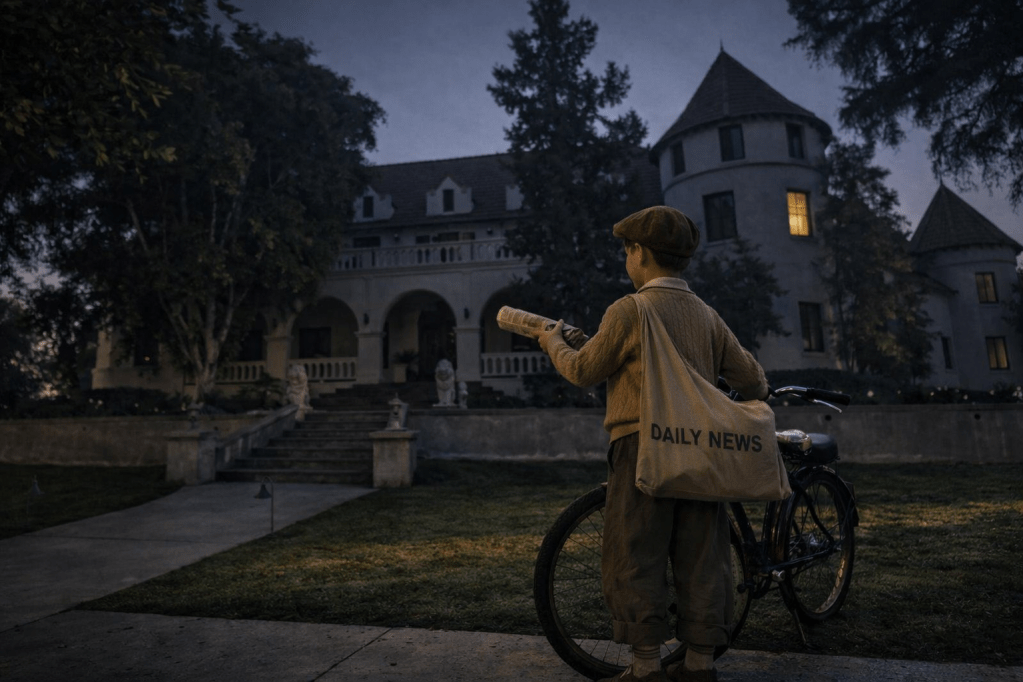
Then one morning, halfway up the stairs, the wind stopped.
Not died down. Stopped. One second the trees were moving, the next they weren’t. The air went thick in a way I didn’t have a word for. Still don’t, exactly. Like the pressure changed.
And then I heard something.
It wasn’t a voice. It wasn’t wind either, because the wind was gone. It was more like the idea of a sound — thin and close, right at my ear — that somehow suggested my name without actually saying it. I know how that sounds. I’m just telling you what I heard.
I kept walking because I was twelve and twelve-year-olds have a gift for ignoring the things that should stop them. I got to the top, dropped the paper in the box, and turned to go.
There was a light in an upstairs window.
Not the overhead fixture. Something smaller, warmer. A candle, maybe, or a lamp with a low-wattage bulb. And a shape behind the glass — not distinct enough to be a person, just a darker shape passing through the light. Then it was gone.
The wind came back. The trees started up again. I went down the stairs faster than I’d gone up and I didn’t look back, which took some doing.
I finished my route. I didn’t tell anybody.
A friend’s apartment
By sixteen I had a driver’s license, which in Los Angeles is a kind of freedom that doesn’t exist anywhere else. You could go anywhere. You could leave. My parents had given me their 58 Chevy station wagon. My dad had finally received the Volkswagen he ordered from Germany.
A kid I knew — not a close friend, just someone I’d drift around with after school sometimes — had an apartment in the old estate. The property had been subdivided at some point, the grounds carved up, units added. It wasn’t glamorous. It was just where he lived.
But where he lived made him interesting.
The first time I went over there, I noticed something in the air the moment I stepped inside. I want to be careful how I say this, because I’m not someone who talks much about feelings or atmospheres or any of that. What I noticed was more like: the air in that apartment felt occupied. Not dangerous. Just like something in there was paying attention.
My friend laughed it off the way people do when they’re not quite laughing it off.
“Yeah, I get these dreams,” he said. He was pouring himself a glass of water, not looking at me. “Like there’s somebody standing over me. Or I hear walking in the hall and I wake up and there’s nobody there.” He drank the water. “It’s probably just the building settling. It’s old.”
He said it like he’d had the conversation with himself before. Like he was still trying to close it out.
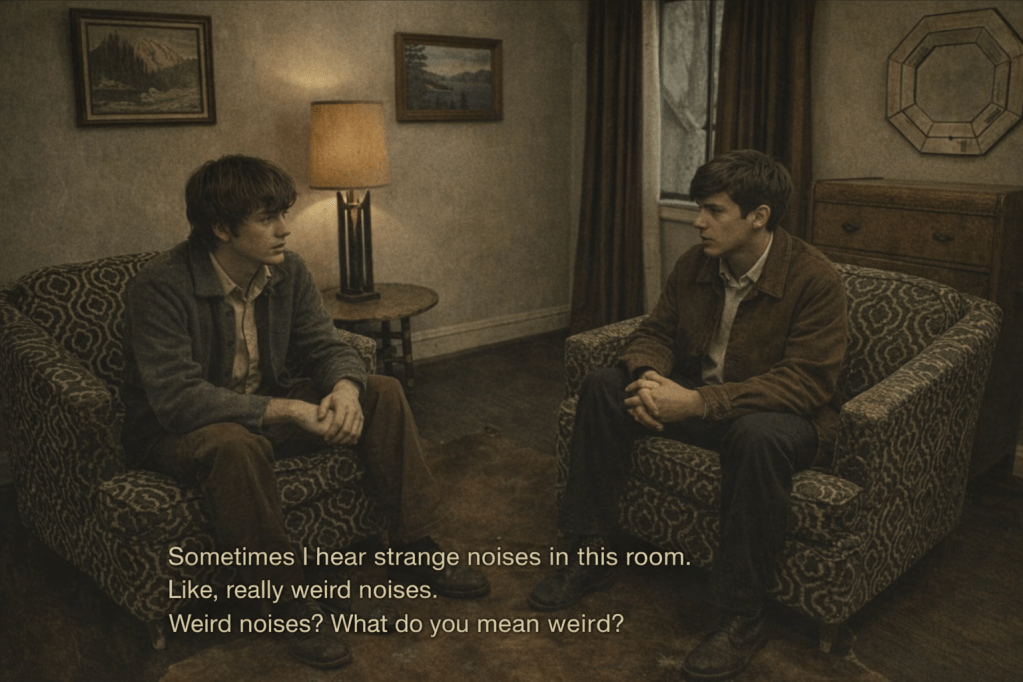
I didn’t stay long. I told myself I had somewhere to be, which I probably did. On my way out I looked up at that same second-floor window — the one with the light I’d seen from the stairway four years earlier.
Dark this time. Just glass.
But I had the feeling I’d had on the stairs. The feeling of being observed by something with a lot of patience.
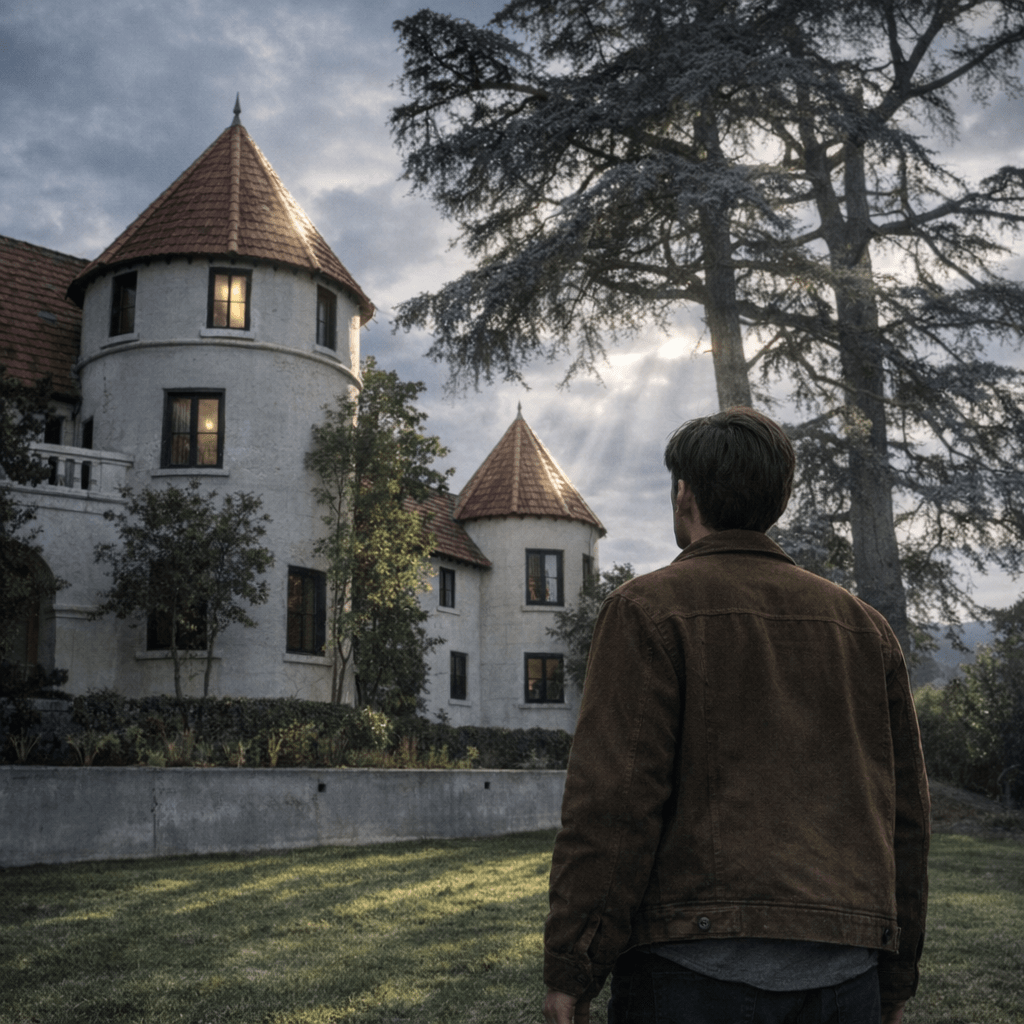
I drove home. I thought about Ricky’s father, who had been a kid in Alhambra before any of us were, and had said: bad things happened up there.
I wondered what kind of bad things he’d meant.
Years later
Life does what it does. I grew up, moved on, moved around. Raised a family. Worked. The castle came up sometimes when I was telling stories — I’d get to the part with the light in the window and people would lean in — but I always left the whisper out. Some things you hold onto for no reason you can name.
Then, decades later, I heard about Phil Spector.
The music producer. Wall of Sound. A woman named Lana Clarkson had died inside the castle. The world had opinions about what had happened and who was responsible, and eventually the courts sorted it out. It was on the news for a long time. A tragedy. A crime. A famous man’s worst hours, preserved and examined.
I watched it from a distance, the way you watch something that lands close to a memory.
What I kept thinking about was Ricky’s father. I kept thinking about the weight in that upstairs apartment. I kept thinking about the light in the window at six in the morning, and the sound that wasn’t quite a voice, and the feeling — which I’d never really shaken — that the building had been accumulating something for a long time before any of us showed up with our newspapers and our Halloween candy.
I don’t know what I believe about places. I’m not sure I believe anything, exactly. But I noticed that I wasn’t surprised. That seemed like it meant something.
The Return
I went back to Alhambra years later. Older, retired, the kind of person who drives past old addresses just to see how wrong his memory has been.
Marguerita Elementary looked like a toy of itself. The streets were narrower than I remembered — which is always how it goes. The neighborhood had changed the way all neighborhoods change, some things upgraded, some things tired, the trees bigger than they had any right to be.
I drove up to Pyrenees and parked at the bottom of the stairway.
The castle looked exactly the same. Not restored, not deteriorated. Just the same. Like it had opted out of time as a general policy.
I got out of the car. The eucalyptus trees were going in that old rattling way. The stairs were still buckled at the roots.
I climbed a few steps. Not to deliver anything, not to see anybody. Just to see if it was still there — the feeling. The awareness.
It was.
The air shifted the same way it had when I was twelve. Not threatening. Not welcoming, exactly. Just registering. Like signing in at a front desk staffed by someone who remembered your name and didn’t particularly care whether you were glad about that.
I looked up at the second-floor window.
For a moment — brief, gone almost before it was there — something moved behind the glass. A flicker. The suggestion of light.
Then just the window. Then the wind again, easy and familiar, moving past me down the stairs the way it always had.
I stood there for a minute. Then I walked back to the car.
I’m not going to tell you the castle is haunted. I don’t know what it is. I know it’s old, and that old things accumulate history the way old wood accumulates weather — not just on the surface but all the way through. I know that when I was ten years old something on that hill caught my attention and held it, off and on, for the next fifty years. The castle is still there, on the hill up Grand View Drive. The name has changed and is now called Wrensmoor Castle and is available on Airbnb if you are adventurous.
That’s not nothing.
Whether it’s something worth writing down — well. You’re reading it. Make of that what you will.
Author’s Note
The Pyrenees castle on the Hill in Alhambra is real, as is its history. Everything else is fiction built on the foundation of a real place that has always seemed, to at least one person who grew up near it, to be holding something it was never meant to hold.
Buckskin Press
 Buckskin Press
Leave a comment